
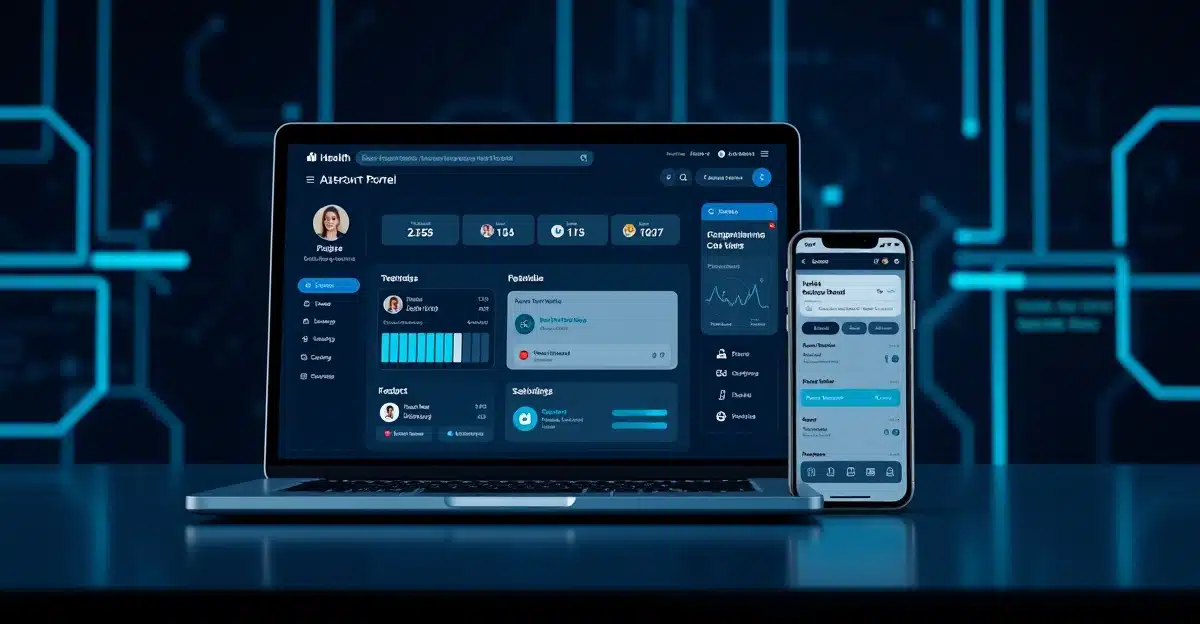
The right patient portal website features aren’t a luxury for healthcare practices — they’re the clearest path to reducing overhead, cutting no-shows, and turning a static web presence into a revenue-generating system. In 2026, patients expect the same digital convenience from their doctor that they get from their bank, their insurer, and their online pharmacy. Practices that deliver it retain more patients and spend less time on phone calls and manual admin. At Nuesion, we build AI-powered web solutions designed to do exactly that. Talk to our team about what a custom patient portal can deliver for your practice.
What Is a Patient Portal Website and Why Does It Matter for ROI?
A patient portal is a secure, HIPAA-compliant web interface that gives patients 24/7 access to their health records, appointment scheduling, billing, secure messaging, and care resources — all without picking up the phone. The ROI case is simple: every task a patient can complete online is a task your front desk doesn’t have to handle. When you multiply that across hundreds of patient interactions per week, the savings stack up fast.
Beyond operational efficiency, patient portals drive retention. Patients who can manage their care digitally — scheduling follow-ups, reviewing lab results, paying bills from their phone — are significantly more likely to stay with a practice long-term and refer family members. Digital convenience has become a baseline expectation, not a differentiator. Practices that don’t offer it are losing patients to those that do.
The Patient Portal Website Features That Drive Real ROI
Not all patient portal implementations are created equal. Generic templates bolt on basic functionality without integrating with your existing workflows, which creates more work instead of less. Here are the patient portal website features that actually move the needle on healthcare practice ROI.
Online Appointment Scheduling
Real-time scheduling that syncs with your practice management software is the highest-impact feature a patient portal can offer. Patients book, reschedule, or cancel on their own time — no hold music, no callbacks. Automated confirmation emails and SMS reminders reduce no-show rates by 15 to 30 percent. For a practice seeing 200 patients per week at an average visit value of $150, a 20 percent no-show reduction recovers over $60,000 per year. That’s a payback period measured in weeks, not years.
Secure Patient Messaging
HIPAA-compliant two-way messaging between patients and care teams replaces hours of phone tag every week. Patients get faster answers to routine questions; staff handles message queues in batches during downtime instead of fielding interruptions throughout the day. Practices that deploy secure messaging consistently report 30 to 40 percent reductions in inbound phone call volume, freeing front-desk staff for higher-value tasks.
Online Bill Pay and Financial Transparency
Patients pay bills the same way they pay everything else: online, on their phone, at their convenience. A patient portal with integrated bill pay accelerates collections, shrinks accounts receivable aging, and cuts the administrative overhead of paper statements and follow-up calls. Faster payments mean healthier cash flow. Clearer billing summaries mean fewer disputes and fewer billing-related calls to answer.
Health Records Access
On-demand access to lab results, visit summaries, immunization records, and care plans reduces records request volume and empowers patients to stay actively engaged in their own care. Engaged patients follow care plans more consistently, show up to follow-up appointments, and stay with practices longer. This feature also positions your practice for value-based care models that reward outcomes over volume.
Digital Intake Forms
Pre-visit digital forms completed at home cut in-office check-in from 15 minutes to under three. Staff spend less time on manual data entry; providers get richer patient history before the visit even starts. For multi-location practices, digital intake is non-negotiable: it standardizes data collection and eliminates the inconsistency of paper-based processes.
Patient Education and Resource Library
A well-organized resource hub — condition guides, post-visit instructions, medication FAQs — reduces the volume of follow-up calls that consume clinical staff time. AI-driven content personalization can surface the right resources based on a patient’s diagnosis or care plan, increasing engagement and improving treatment adherence without any manual effort from your team.
At Nuesion, we design and build custom web solutions that bring all of these features together in a system built around your workflows, not a generic template. Here’s how the ROI breaks down in practice.
How Patient Portal Features Impact Healthcare Practice Revenue
The ROI of patient portal website features operates across three dimensions: revenue recovery, operational savings, and long-term patient retention.
Revenue Recovery: Appointment reminders and online scheduling reduce no-shows. Cancellation slot alerts fill gaps faster. Online bill pay speeds collections. Each of these has a direct, measurable dollar value tied to your patient volume and average visit revenue.
Operational Savings: Practices that fully implement patient portal functionality typically reclaim 10 to 15 staff hours per week through reduced call volume, manual scheduling, records requests, and payment follow-up. At a fully-loaded labor cost of $25 to $40 per hour, that’s $13,000 to $31,000 per year in recovered productivity per location.
Patient Retention: The lifetime value of a retained patient dwarfs acquisition cost. Patients who find their portal convenient return for routine care, refer others, and are less likely to switch providers over minor friction. Digital convenience is now a loyalty driver on par with clinical quality and location.
Common Patient Portal Mistakes That Kill ROI
Many healthcare practices invest in a patient portal and see minimal return. In most cases, the culprit is the implementation, not the concept.
No mobile optimization. More than 70 percent of patients access their portal from a smartphone. A portal that works on desktop but breaks on mobile loses most of its audience before they ever log in.
Bolted-on rather than built-in. A generic plugin layered onto an existing website is not a patient portal. Portals need their own UX architecture, designed around patient workflows from the ground up.
Missing EHR integration. A portal that doesn’t sync with your scheduling or billing software creates manual reconciliation work. The point of a portal is to eliminate manual processes, not add new ones.
No patient onboarding strategy. A portal patients don’t know about or can’t register for has zero adoption and zero ROI. Launch communications, in-office prompts, and a clear registration flow are essential.
HIPAA compliance as an afterthought. Data security isn’t a checkbox: it’s a technical architecture decision that affects every layer of the system. Getting this wrong isn’t just a business risk; it’s a legal one.
The Nuesion Approach to Patient Portal Website Development
Standard patient portal templates don’t deliver the ROI outcomes described above. Custom, AI-enhanced patient portal website features do. Nuesion designs and builds patient portals that are integrated with your existing practice systems, mobile-first by default, HIPAA-compliant at the architecture level, and conversion-optimized at every patient touchpoint.
We’ve worked with service-based businesses and professional practices across Houston and beyond to build web systems that generate real, measurable results. Our process starts with your workflows, your patient demographics, and your ROI targets — then works backward to the right feature set and the right technical approach.
If your practice is still handling scheduling, billing, and records requests by phone and paper, you’re leaving significant revenue on the table. The right patient portal website features pay for themselves, often within the first year. Start the conversation with Nuesion and we’ll map out the specific ROI opportunity for your practice size and specialty.